
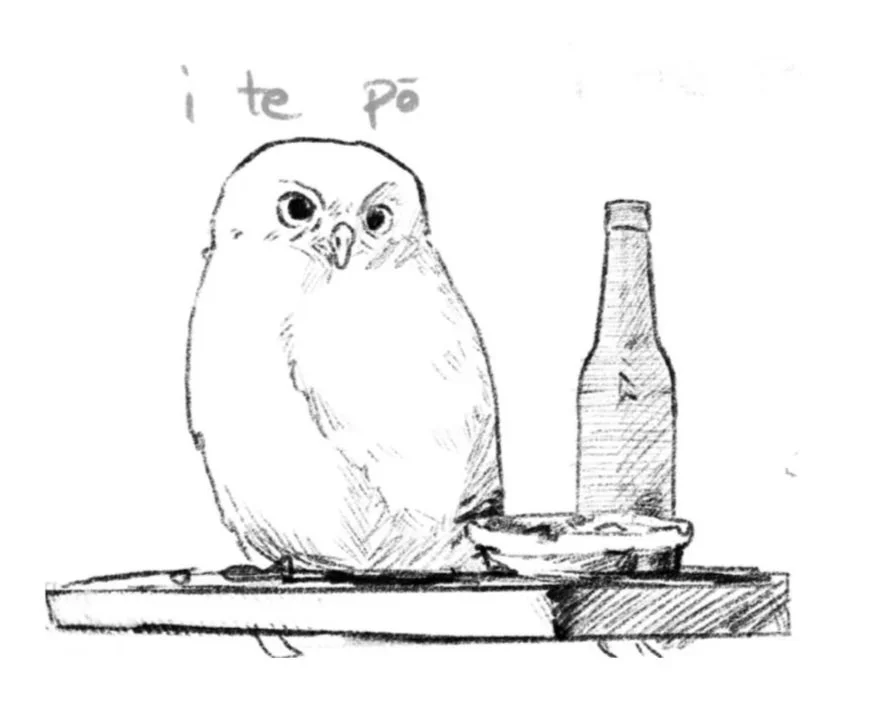
i te pō
the sun sets.
i paint my mouth with black lipstick
that was on special from the chemist.
it reminds me that there’s
a moko under the skin of these lips.
i’ve seen the influencers stamp on a kauae
that’ll run when their makeup does
and i wonder what the tikanga is about that.
i pick kawakawa off the tree and
fill my pockets on the way out to town,
where i will feed it to my girls
because a man provides;
because a native forages.
we start at a pub.
bring our drinks to the outside tables.
two pale girls try
handing their IDs to us,
assuming every brown boy outside a bar is the bouncer.
“how many bouncers you seen sitting
with a drink in their hand and a girl on their lap?”
he asks them.
a waiata is sacred,
a kanikani is scared,
but i wouldn’t call the club tapu.
the bartenders a real g,
gives us doubles for cheap,
turns out he’s my mum’s friend’s son.
we fill the toilet stall with too many bodies.
exiting the cubical is like being born anew.
like every birth there’s a babe crying
this time a stranger in tears.
in the smokers area
i ask a girl if she’s māori too
and she tells us she doesn’t know if she counts
and we take her by the hands and
remind her that she doesn’t need paperwork to be one of us.
she says, “but i don’t know my iwi”
and we tell her tonight it doesn’t matter
because she’s our cousin now,
and we offer her a dart.
she accepts.
in the city i hear ruru and cop sirens
in the distance all night long;
we hear a bird that whistles even after dark
and we can’t identify it
no matter how long i spend on google,
the newest kete of knowledge.
we’re out until dawn,
my little pacific family,
stumble back to someone’s flat,
and sit out on the balcony while they bring us cuppas.
and under the light of the waking tama-nui-te-rā
my friends teach me words from their languages
and the conversation is beautifully stilted,
because we’re always stopping to say
how similar our kupu are.